Success Story

From Two Weeks to Minutes: HFW Companies Rebuilt Its Financial Package on Microsoft Fabric




<30 mins
to report

100 Tabs

2 People

1 Model
On day one after month-end close, the Financial Package is already built. The finance team’s job shifts from two weeks of manual assembly to reviewing, adjusting, and signing off. The data platform on Microsoft Fabric behind it runs the entire cycle automatically every night. The team’s time now goes where it creates the most value: strategic analysis, scenario modelling, and partnership with the business on the decisions that move the company forward.
This is the second chapter of HFW’s data journey. In the first, the company unified thirteen ERPs into a single analytics foundation on Microsoft Fabric in ninety days. In the second, that foundation was extended into the heart of how HFW runs its finance function. Since then, the group has continued to grow, with one further acquisition bringing HFW to fourteen business units by April 2026.
A Financial Package That Leadership Depends On
HFW Companies is a national group of architecture and engineering firms that has expanded rapidly through acquisition. Every month, the finance organisation produces a Financial Package for the board and investors. It is one of the most visible documents the company produces, and the standard for accuracy is absolute.
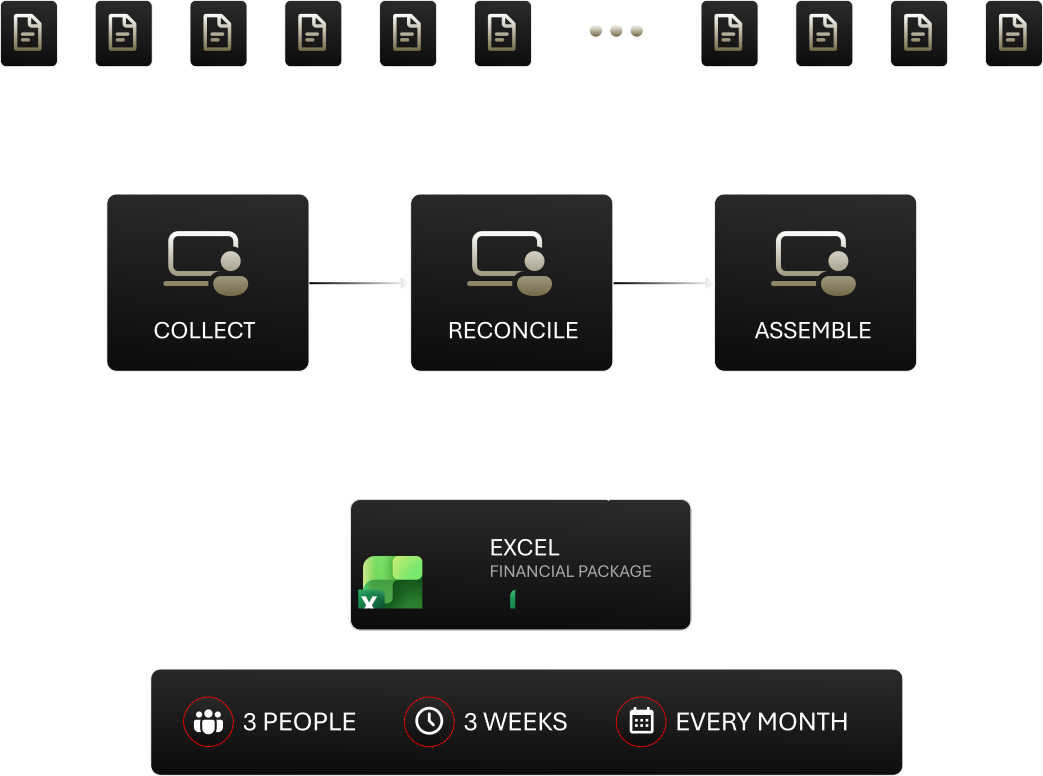
The process that produced this package had evolved alongside the business. Three full-time members of the finance team spent two weeks every month collecting data, reconciling it manually across fourteen business units, and stitching it together in Excel. The team delivered what leadership needed each month, though the work consumed significant capacity that the executive team saw could create more value elsewhere.
14 business Firms
Leadership Set the Bar Before the Technology
The transformation started with a conversation about expectations, not about tools. The executive team agreed on three principles that would shape every decision that followed:
- Every number in the Financial Package would have one unified definition.
- Accuracy would be held without compromise.
- Finance would own the definitions, with technology following the business rules rather than the other way around.
Shreena Fulani, Director of Business Intelligence, led the transformation on the HFW side, working with Landon Bradford, Business Intelligence Analyst, to extend the Medallion architecture established in the first phase of HFW’s data journey into a finance-grade data platform on Microsoft Fabric.
Michelle Huber, Senior Vice President of Finance, and Becky Garner, Accounting Manager, drove the accounting and finance side of the transformation, working hand in hand with the BI team. The depth of financial knowledge they brought shaped how every definition, mapping, and reconciliation rule was designed, and turned a technical platform into a finance-grade one.
Typical approach

Technology Decision

Business Adapts

Ongoing Friction

Definitions Drift. Trust erodes.
HFW approach

Agree the principles

Finance owns definitions

Platform Follows

One source of truth, trusted by all
A Finance-Grade Data Platform on Microsoft Fabric
Data flows directly from every ERP into Microsoft Fabric. Every chart of account mapping and every manual adjustment lives in one governed place, where finance maintains the logic behind every consolidated number. From that single source of truth, the platform runs:
→ Automated reconciliation across all fourteen business units – and every new acquisition onboards into the same framework
→ Validation rules at every stage of the pipeline
→ Trial balance checks every month
→ A completeness and accuracy check before any number reaches a report
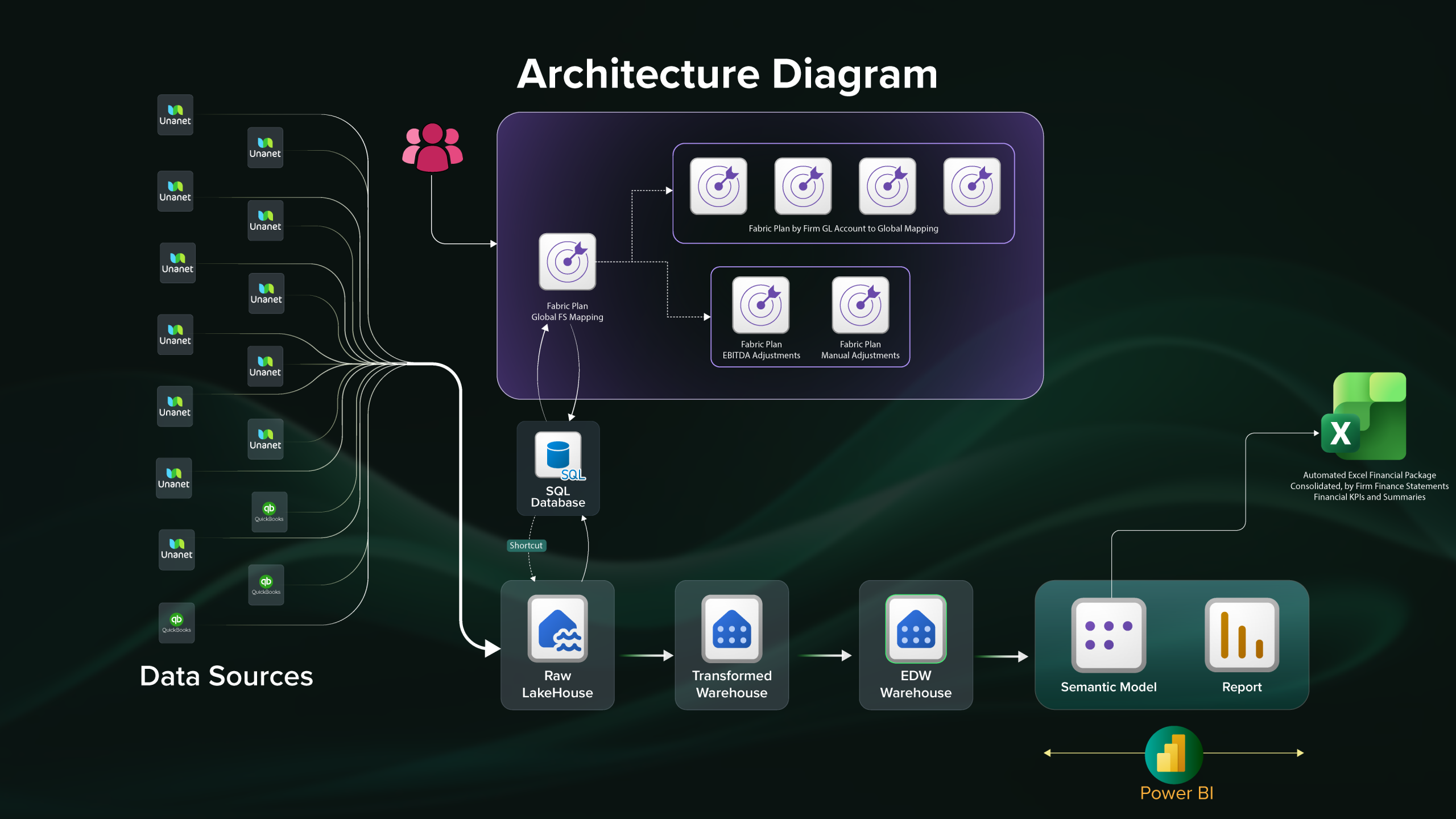
The platform follows the Medallion architecture from HFW’s first data foundation. Raw data lands first, then a unified business layer governs how revenue, cost, account, entity, and period are interpreted across the group, and the semantic model that drives the Financial Package sits on top. Inside that unified layer, Fabric Planning with its Data Management capability (formerly PowerTable) holds every chart of account mapping and every manual adjustment under an approval-based policy. Changes are proposed, reviewed, recorded, and traceable. The metadata that defines how the Financial Package comes together is owned by finance and ready for audit at any time.

Shreena Fulani,
Director of Business Intelligence, HFW Companies
A validation framework sits above the foundation. External trial balances are kept apart from the transactional systems, and the platform reconciles its own trial balance against them every month. A dashboard tracks the process, and the moment a GL account breaks tolerance, it is flagged at the account level with full lineage back to source. The finance team sees the issue, traces it, and resolves it well before it reaches a report.
On top sits the Power BI semantic model that drives the Financial Package. Excel connects to it live, so the P&L, balance sheet, and cash flow all draw from one governed source. The pipeline refreshes every night, which turns the financial close from a monthly event into any-day visibility. Leadership can open the package on any day of the month and see where the business stands, confident that the numbers have already been reconciled, validated, and signed off by the platform.
Excel Is Still Where the Last Mile of Finance Happens
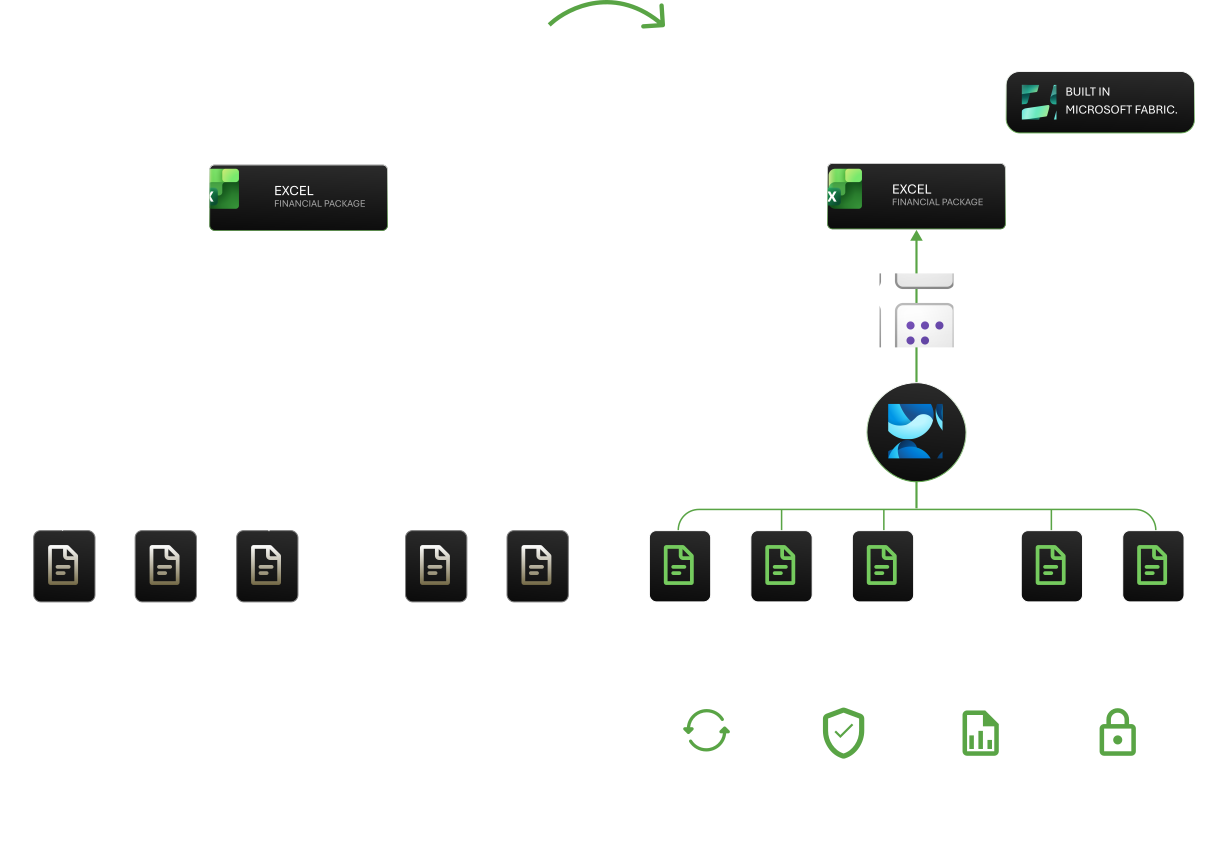
Excel remains the place where ad hoc analysis gets done and where the last mile of finance work lives at HFW, and that was never going to change. What changed is what Excel is now connected to. Anyone who has produced a monthly Financial Package in Excel alone knows the risks that come with it: manual stitching across multiple files, broken links, reconciliations done by hand, and updates redone every time a number moves. With a governed foundation underneath, those risks stay out of the process. Every number in the file flows live from the semantic model, every calculation refreshes from a single trusted source, and what needs to land in Excel now lands in minutes.
Excel: Same experience, new foundation.
Same Excel, different foundation.
Excel stays where finance works. The risk is removed from underneath.
New Acquisitions, Reporting-Ready From the Start
HFW grows through acquisition. The same foundation that powers the Financial Package now absorbs new companies directly into the reporting cycle. The company acquired in April 2026 was integrated into the Financial Package the same month, a process that would have taken a year or more under the previous model. Finance is no longer a bottleneck to the acquisition strategy.
Same Month, Without the Manual Rebuild


Before



Now
One onboarding step, run on the framework that already exists

Why it worked
Proof in results. clarity in impact.
Before
After

Data
Availability
3 weeks

<30 Mins

Reporting
cycle
Up to 2 months
4 Weeks
(Reducing)

Accuracy
assurance
Manual
Automated

Acquisition
Integration
Weeks to
months
Same Month

Role of
Finance
Assembling &
Reporting
Analysis and
Partnership
Technologies Used







A Partnership That Went Beyond Technology
HFW’s finance team partnered with Data Crafters throughout the build. Alongside the Fabric implementation, Data Crafters supported Michelle and her team on the process and finance side: designing the monthly workflow, translating accounting standards into reconciliation rules, and bringing finance-industry experience into the definitions themselves. The platform and the finance logic were built together, which is why the result reflects how HFW’s finance function actually works.
What's Next
With the Financial Package running on a nightly cycle, HFW is preparing the next wave of work: Data Agents that answer finance questions conversationally. Deeper scenario modelling for acquisitions. Extension of the same foundation into additional finance and operational domains.
Modern finance starts
with data you can trust

Shared revenue
definitions

Reports reconcile
before sign-off

Less manual work
every close.

Audit ready
governance
The Lesson for Finance Leaders
AI is only as good as your data, and in finance the bar for data is absolute. The value of a modern finance platform comes from unified definitions, clean reconciliation, clear ownership, and the steady removal of manual steps from the reporting cycle.
Microsoft Fabric and Power BI make the build possible. A finance team backed by an executive team that holds the standard makes it real.
Whether an organization runs fourteen ERPs or one, the path is the same.
Four pillars. lasting impact.

Plan

Manage

Grow